


For decades, low-and-slow pitmasters faced a fundamental trade-off during long brisket cooks: wrap early to preserve moisture, or stay unwrapped to protect the bark.
The traditional "Texas Crutch", wrapping tightly in aluminum foil, speeds up the cook and tenderizes the meat, but the trapped steam often softens your bark into a soggy mess. Pink butcher paper emerged as a popular middle ground, allowing the brisket to breathe while retaining juices, but it still dampens the top crust to some degree.
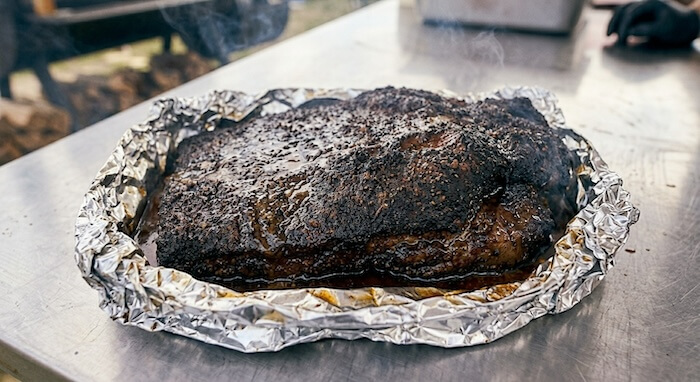
Enter the foil boat brisket method. Pioneered by top Texas pitmasters and gaining massive traction across the competition circuit, this hybrid technique gives you the best of both worlds. By constructing an open-topped aluminum foil vessel, you submerge the bottom of the brisket in its own rendered fat while leaving the top bark fully exposed to heat and smoke.
In this article, we’ll break down the science behind why the foil boat method works so well and how to do it just like a pro pitmaster.
To understand why the boat technique works, you have to examine what happens during the stall. Around an internal temperature of 150 to 165 degrees Fahrenheit, evaporative cooling slows the cook.
When you evaluate a foil boat vs butcher paper brisket, the key difference lies in steam management:
If your primary goal is achieving an incredible, mahogany-to-black crust with crunch, mastering this hybrid setup is a game-changer. Learn more about the chemistry behind flavor development in our breakdown on getting perfect bark on meat.
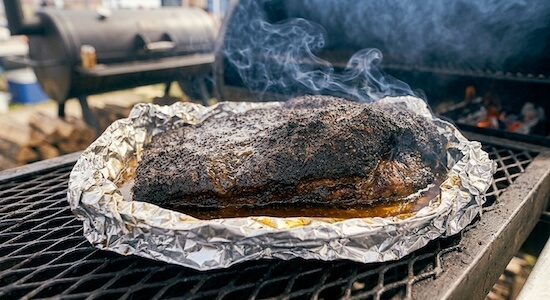
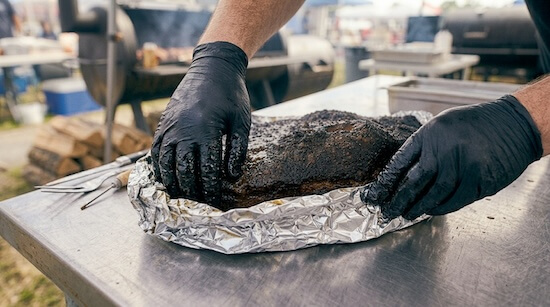
Knowing how to build a foil boat for brisket requires clean geometry and proper timing. You don't boat the brisket right at the start of the cook; you wait until the top bark is fully set and resilient.
Place your seasoned packer on the smoker unwrapped. Let it take on heavy smoke for 6 to 8 hours (typically until reaching 160 to 170 degrees Fahrenheit internally). Before building your boat, verify that the bark won't scratch off when gently rubbed with a gloved finger.
Keep the top half completely exposed. Return the boated brisket to the smoker and continue cooking until the flat probes like soft butter, usually around 200 to 205 degrees Fahrenheit.
The foil boat brisket method solves one of barbecue's toughest dilemmas: choosing between incredible bark and juicy flat meat. By sheltering the bottom while unleashing heat on the top, you get competition-grade results in your own backyard.
However, building the boat is only one piece of the puzzle. Managing your fire, adjusting airflow, and knowing precisely when to pull and rest the brisket determine whether you walk away with a trophy or an overcooked flat.
Ready to master world-class brisket from start to finish? Here at BBQ Champs Academy, we give you step-by-step video instruction from legendary Grand Champion pitmasters and grillmasters. Learn exact trim blueprints, secret rub layering formulas, and pit-tested resting techniques used on the professional circuit. Grab your All-Access Pass today and unlock pro barbecue mastery!


