


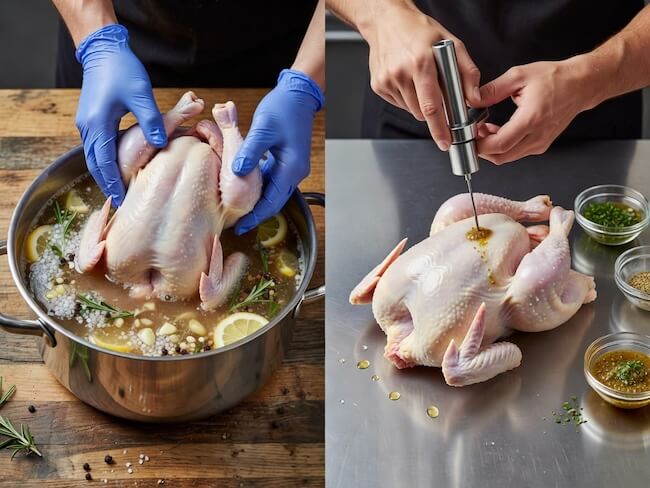
If you’ve ever pulled a chicken off the smoker only to find the breast meat resembles a dry piece of balsa wood, you know the unique frustration of backyard barbecue. Poultry is notoriously unforgiving. Because it is lean, the window between perfectly cooked and hopelessly dried out is incredibly small.
To combat this, pitmasters rely on two heavy-hitting techniques to lock in moisture and layer in flavor before the bird ever touches the grate: brining and injecting. But when it comes down to the great debate of brine vs injection for smoked chicken, which method reigns supreme?
The professional Pitmasters here at BBQ Champs Academy have spent years firing up smokers, tweaking competition recipes, and testing these methods head-to-head. In this article, we break down the science, the flavor profiles, and the logistics behind both options so you can confidently decide whether to brine or inject smoked chicken for your next backyard cookout.
Wet brining is the classic approach. At its core, a brine is a solution of water and salt, though it’s usually amped up with brown sugar, black peppercorns, apple juice, and fresh herbs.
Brining relies on a beautiful bit of kitchen science known as osmosis. When you submerge poultry in a saltwater solution, the salt disrupts the tightly coiled muscle fibers in the meat. This process, called denaturation, causes the protein strands to unwind and relax. As they relax, they create tiny pockets that draw in and trap the surrounding moisture.
Even as the chicken cooks and the proteins inevitably contract, they hold onto that extra water. The result? A remarkably forgiving piece of meat that stays juicy even if your smoker temperature spikes.

If brining is a long, soothing bath, injecting is a targeted, high-powered strike. Using a specialized meat injector syringe, you pump a flavorful liquid directly into the thickest muscles of the bird. Typical injection liquids include a mix of chicken broth, melted butter, Worcestershire sauce, fruit juices, and fine-ground dry rubs.
Unlike osmosis, which takes hours to slowly work its way from the outside in, injection bypasses the surface entirely. You are mechanically forcing moisture and targeted fats (like butter or olive oil) straight into the deep interior tissue where dryness happens first.

When weighing brine vs injection for smoked chicken, consider your timeline and your ultimate flavor goals.
| Feature | Wet Brining | Injecting |
| Prep Time Needed | 4 to 24 Hours | 10 Minutes |
| Skin Texture Potential | Rubbery (requires air-drying to fix) | Crisply efficient |
| Flavor Delivery | Subtle, well-rounded, and uniform | Intense, targeted, can include fats |
| Equipment Needed | Large bucket or pot, fridge space | BBQ meat injector syringe |
If you are smoking a whole bird or a batch of chicken quarters and have the luxury of time, it is often better to go with a wet brine because of the edge-to-edge structural moisture it provides. However, if you are cooking strictly chicken breasts, or are short on time and want to make sure your skin turns out incredibly crispy, injection is the undeniable winner.
Ultimately, choosing brine vs injection for smoked chicken depends entirely on what you want out of your final bite. Wet brining is the champion of uniform tenderness and structural moisture retention, making it a great baseline for whole birds. On the flip side, injection gives you unmatched speed, crispy skin protection, and the ability to pump rich, buttery fats right into the core of the meat. Both techniques belong in your culinary arsenal, and mastering the subtle balance between them is exactly what separates casual backyard cooks from true pitmasters.
Ready to stop guessing and start dominating your backyard or the local competition circuit? If you want to look over the shoulders of the best in the business, check out the online BBQ cooking classes here at BBQ Champs Academy. You can learn the exact, step-by-step poultry techniques, exact injection recipes, and wood selection secrets taught by multi-time World Champions and legendary Pitmasters. Get elite-level access to all of our courses, recipes, and video breakdowns by grabbing your All-Access Pass today!


